How to Grow Cherry Tomatoes Indoors: 60 Days, No Yard
How to Grow Cherry Tomatoes Indoors: 60 Days, No Yard
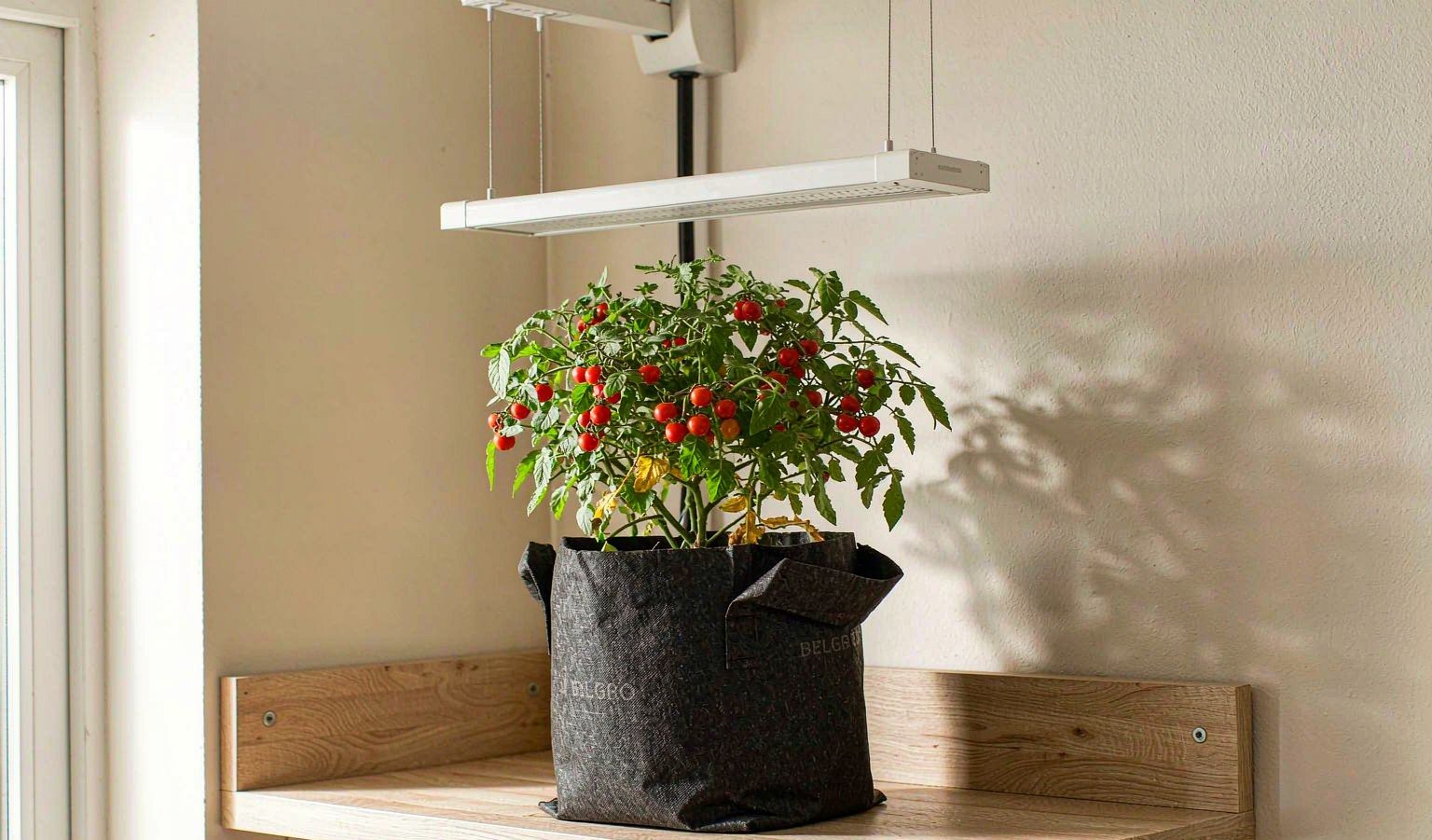
Store-bought cherry tomatoes have gotten expensive and bland at the same time, which is a bad combination. Container growing looks like the obvious way out, right up until the plant spends three months getting tall and green and refuses to make a single tomato.
How to grow cherry tomatoes indoors comes down to four things: a variety bred for small containers, more light than any window will give you, a pot big enough to survive one missed watering, and about thirty seconds of flower-tapping every morning. Miss any one of them and you get foliage instead of fruit. That’s where most first attempts stall out.
The setup below fits in an apartment. No yard, no grow tent, no countertop hydroponic tower with proprietary pods. One shelf, one light, one plant to start.
Budget around $70 if you start from seed, or closer to $40 if you buy a nursery seedling and skip the first month.
What You Need Before You Start
Here’s the full list:
- One dwarf or micro-dwarf cherry variety, either seeds or a nursery seedling
- A full-spectrum LED panel or bar rated at 30 watts or more for a single plant
- A 5-gallon fabric grow bag, with drainage holes
- Soilless potting mix, never garden soil
- Liquid tomato fertilizer near 5-10-10, for after the flowers open
- Something to move the air, like a small clip-on fan on its lowest setting
- A way to check moisture. A finger works fine; A soil moisture meter is worth it if you’d rather not guess.
Run two checks before planting anything. Put the light where the top of the plant will be in six weeks and confirm you can hold it 12 inches above the canopy. Then confirm you can reach the plant every morning for two minutes. If either answer is no, wait until it’s yes. A tomato getting 80 percent of what it needs will still drop its flowers.
Step 1: Pick a Variety That Fruits Indoors
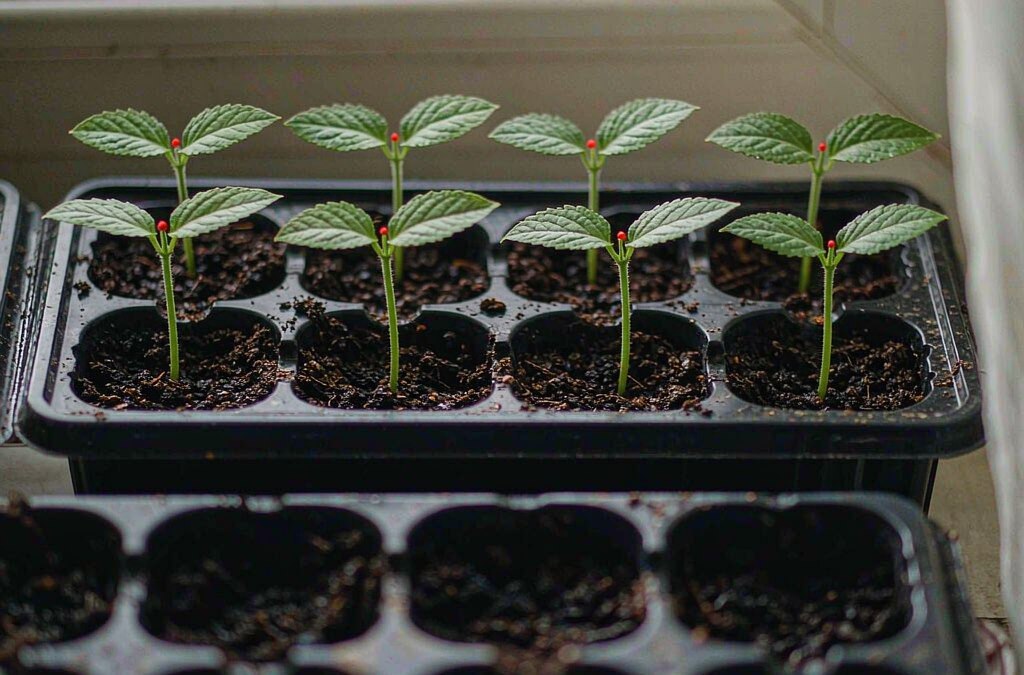
Variety does more work here than any other single choice. A standard indeterminate like Sungold or Sweet 100 runs 6 to 8 feet and will take over a windowsill. Micro-dwarf and compact determinate types stay under 18 inches and ripen in 55 to 70 days from sprout.
Names worth hunting for: Tiny Tim, Micro Tom, Red Robin, Patio Princess, and Tumbling Tom if you’d rather grow in a hanging basket. All five were selected for container life, so they handle tighter roots and lower light better than a slicing tomato will.
Dwarf cherry tomato seeds cost a few dollars a packet and give you far more say over variety than whatever the garden center happens to stock. The tradeoff is seed count: micro-dwarf packets often hold only 10 to 15 seeds, so a patchy germination rate actually hurts. Sow three or four per cell and thin to the strongest.
Checkpoint: the first true leaves show up 10 to 14 days after sowing, and flower buds appear around week six.
Step 2: Get the Light Right
This is where indoor tomatoes die. A south-facing window peaks somewhere between 100 and 500 µmol/m²/s around midday and falls off hard on either side of that. Cherry tomatoes need sustained light well above the bottom of that range, held for 14 to 16 hours a day, before they’ll hold onto a flower cluster.
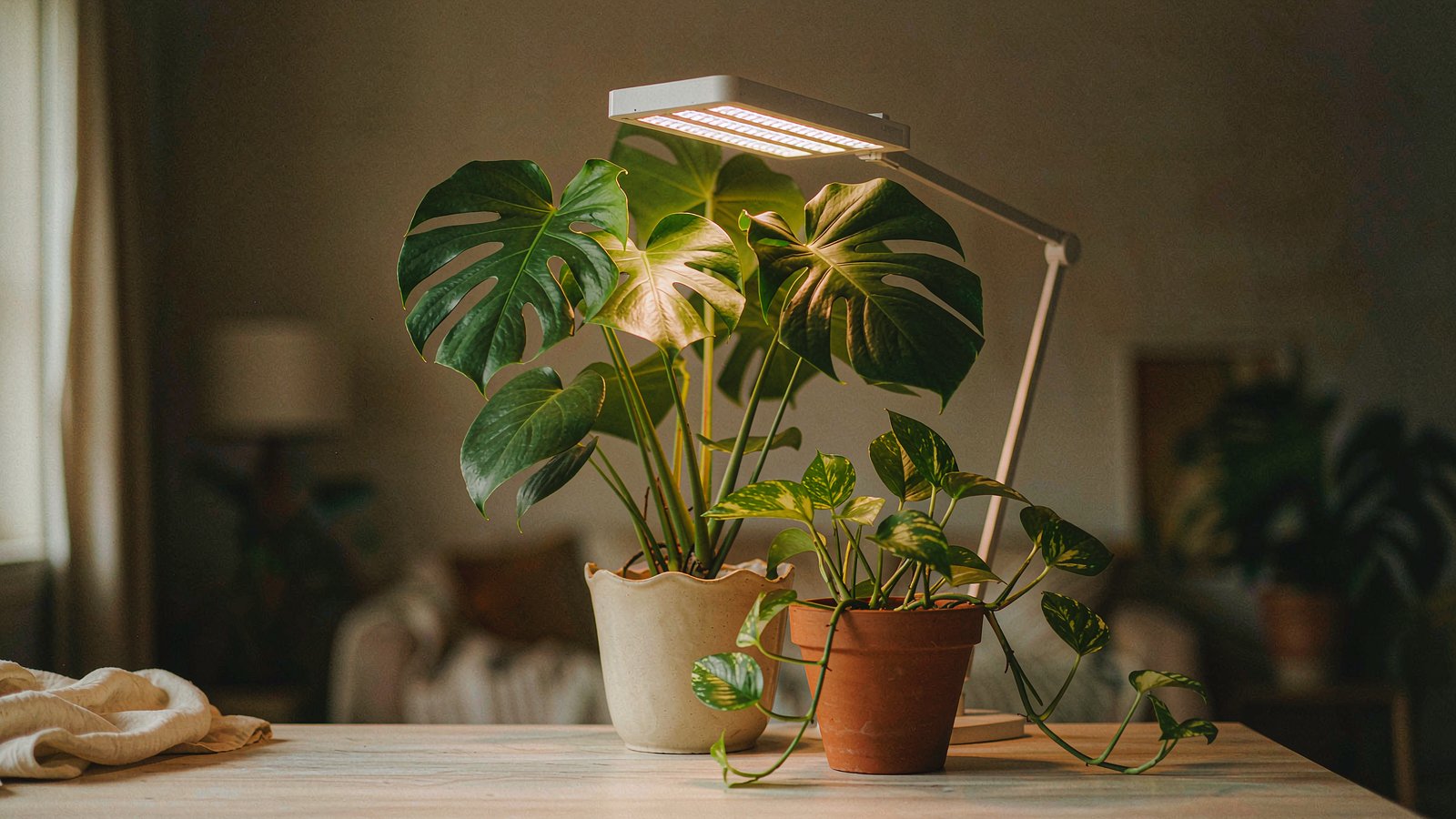
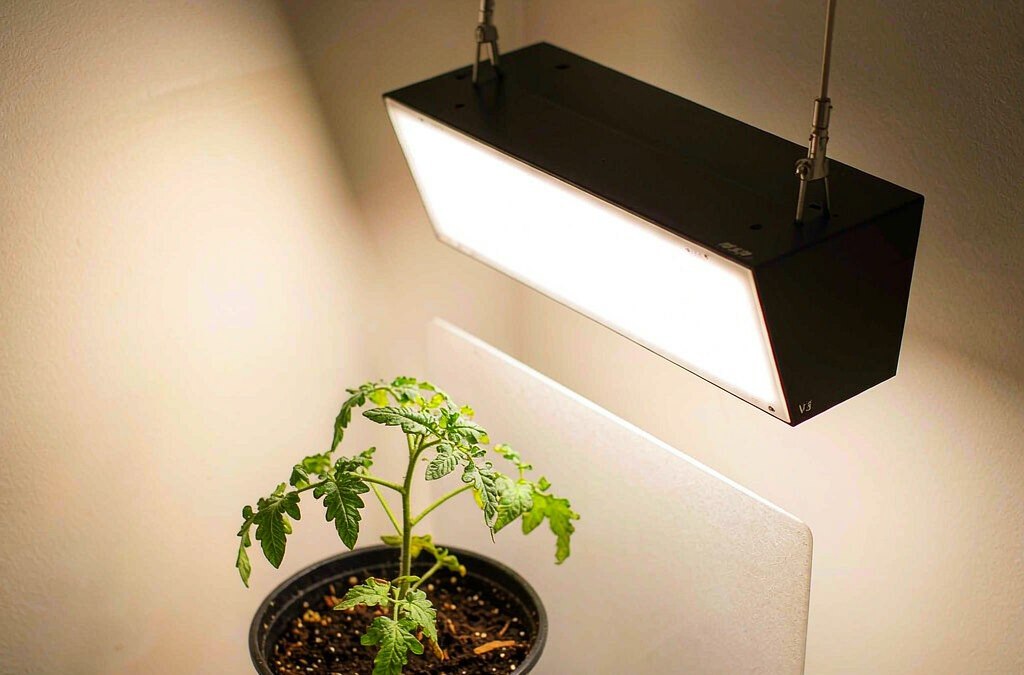
Hang a full-spectrum LED grow light about 12 inches above the top leaves and run it 14 to 16 hours on a cheap mechanical timer. Raise the fixture an inch a week as the plant grows rather than setting it once and walking away. A piece of white foam board taped behind and beside the pot bounces roughly 30 percent more light back into the lower leaves, where the fruit clusters form.
One caveat on cheap panels: the wattage printed on the box usually counts the power supply, not the diodes, so a “40W” light may deliver far less at 12 inches than you’d expect. Blurple red-blue units grow fine but make yellowing leaves and spider mites nearly impossible to spot. Spend a little more for a white full-spectrum panel you can inspect a plant under (see our grow lights for indoor plants guide for the three specs that actually matter).
Checkpoint: a stocky stem, dark green leaves, and the first flower cluster within six to eight weeks. A thin stem with long gaps between leaf nodes means the light sits too far away or runs too few hours.
Step 3: Choose the Right Pot and Soil
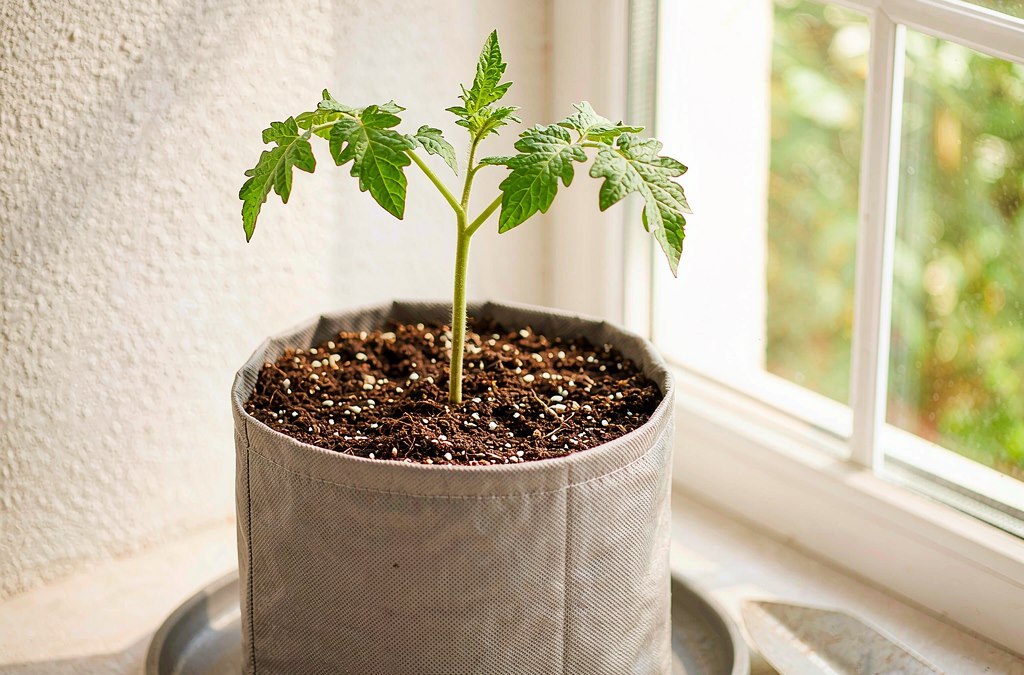
Go bigger than feels necessary. Five gallons is the floor for a cherry tomato, and a 10-gallon fabric bag buys you a buffer against one hot afternoon and one forgotten morning. Whatever you choose needs drainage holes and a tray under it.
Use soilless potting mix, the fluffy peat or coco blend with perlite in it. Garden soil compacts inside a container, smothers the roots, and carries pests you don’t want in the kitchen.
Plant deep. Bury two-thirds of the seedling stem at transplant time, because tomatoes root along any buried stem and you’ll end up with a much stronger base. One plant per pot, even though the seedling looks absurdly small going in.
A fabric grow bag is the usual pick: cheap, air-prunes roots so they branch instead of circling, and folds flat into a closet over winter. The catch is that fabric dries out fast in a heated room and leaves a damp ring on a wood floor, so budget for a tray.
Checkpoint: water should reach the drainage holes within a few seconds of hitting the surface. If it pools and sits, the mix is too heavy.
Step 4: Water and Feed on a Schedule
Water when the top inch of soil feels dry, not on a calendar. Push a finger in to the first knuckle. In a 5-gallon bag in a warm room that works out to roughly every other day; in a small plastic pot on a sunny shelf it may be daily.
Then water deeply, until it runs out the bottom, and dump the saucer 30 minutes later. Roots sitting in water rot. Swinging between bone dry and soaked is what causes blossom end rot, the dark leathery patch on the bottom of the fruit, because the plant can’t move calcium through the fruit without steady water. It isn’t a shortage of calcium in the soil.
Hold the fertilizer until the first flowers open. From there, feed at half the label rate every 10 to 14 days with something high in phosphorus and potassium, like a 5-10-10. Too much nitrogen early gives you a gorgeous bushy plant that won’t set fruit, which is the second most common letdown after weak light.
A liquid tomato fertilizer is cheap and easy to dose, and it smells like a pond. Pour it at full strength on a young plant and you’ll burn the root tips, setting yourself back a couple of weeks.
Checkpoint: the soil surface looks dry and slightly cracked right before you water, and a wilted plant perks back up within an hour.
Step 5: Hand-Pollinate So Flowers Set Fruit
Tomato flowers self-pollinate, but the pollen only drops when something shakes the flower. Outside, wind and bees handle it. Indoors, nothing does, so unpollinated blossoms turn yellow and drop.
Every morning, tap each flower cluster with a finger, or press an electric toothbrush against the stem behind it for a second or two. Mid-morning works best, once humidity drops and the pollen loosens. Aim for 40 to 60 percent humidity and keep air moving with a small clip-on fan on low, pointed at a wall instead of straight at the plant. A fan aimed directly at the leaves dries them out and knocks a young seedling sideways.
Checkpoint: a pollinated flower sheds its yellow petals within two or three days and leaves a small green bead at the base. No bead after a week means no tomato.
When Things Go Wrong: Five Fixes
| What you see | Usual cause | Fix |
|---|---|---|
| Tall thin stem, long gaps between leaves | Not enough light | Drop the fixture to 6 inches and run 16 hours |
| Flowers open, then drop | No pollination, or a room above 85°F or below 55°F | Tap clusters daily; move the plant off the vent or away from cold glass |
| Lower leaves yellowing | Overwatering, or nitrogen shortage | Let the top two inches dry before watering; start feeding at half strength |
| Dark sunken patch on the bottom of the fruit | Uneven watering | Switch to the finger test, keep moisture steady |
| Fine webbing or sticky leaves | Spider mites or aphids | Rinse the plant down, then insecticidal soap, weekly for three weeks |
Nearly every indoor tomato problem traces back to light or water. Check those two before buying anything else (the container gardening mistakes post covers the watering half in detail).
Small-Space and Budget Variations
Countertop, single plant. Micro Tom in a 1-gallon pot under a 20-watt clip lamp. You’ll pick a handful at a time, which is plenty for salads.
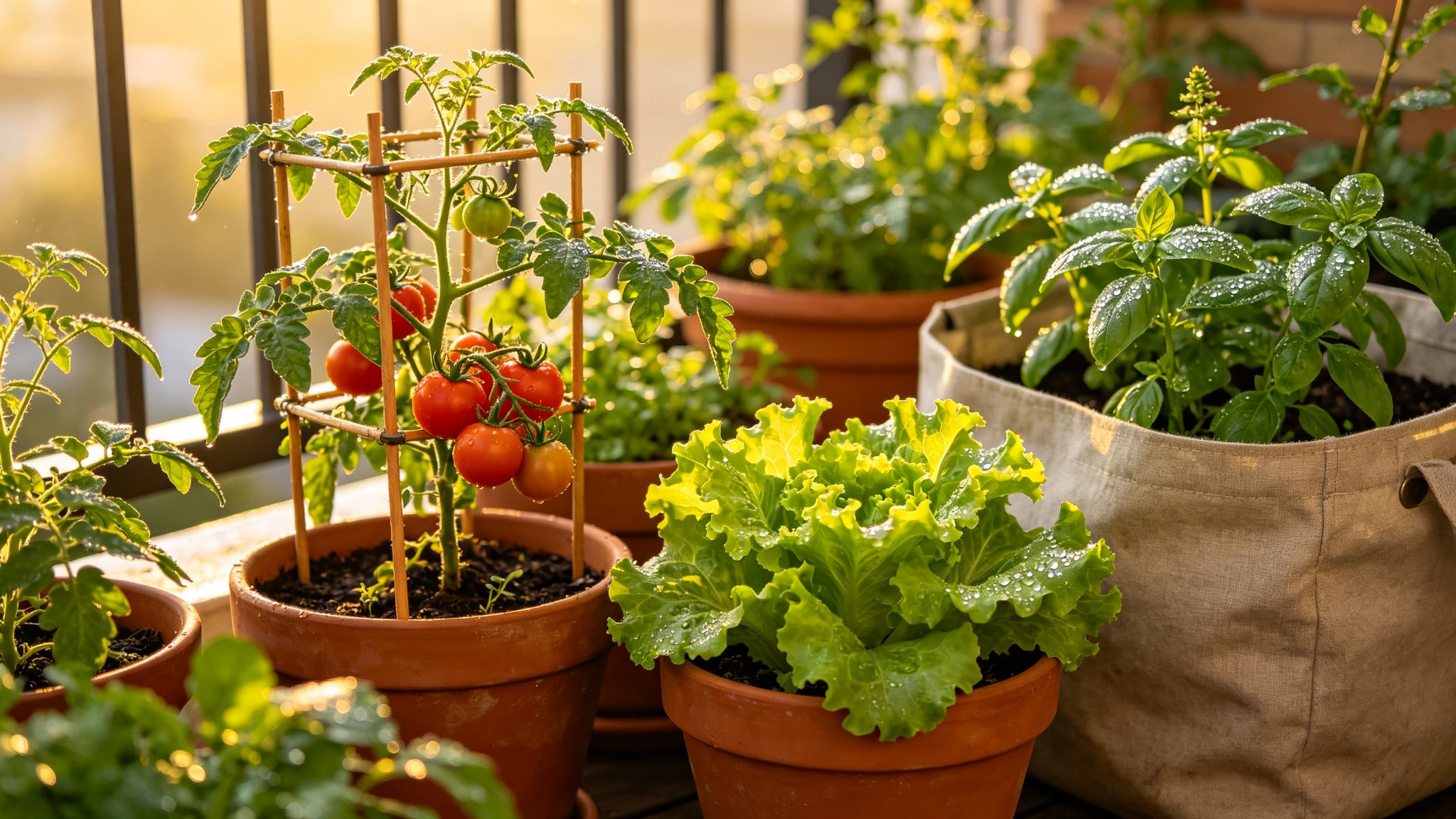
Balcony with real sun. Skip the panel, use a 10-gallon bag, and add a windbreak if you’re above the third floor. Watering becomes the entire job.
Cheapest route. Buy a $5 nursery seedling in spring rather than starting seeds. You give up the variety choice and skip four weeks plus the germination gamble.
Hydroponic countertop unit. Genuinely convenient, and it takes water and feeding off your plate. It runs three to five times the cost per tomato, and you’re locked into the manufacturer’s seed pods.
FAQ
Can you grow cherry tomatoes indoors without a grow light?
Not reliably. Even a bright south window usually delivers usable light for only a few hours a day, and the intensity falls off fast on either side of noon. Most cherry tomato varieties need sustained light well above that to hold a flower cluster, so a window alone tends to give you leaves instead of fruit. A basic full-spectrum LED panel is the fix.
How long do cherry tomatoes take to produce fruit indoors?
From seed, plan on 60 to 80 days to ripe fruit with dwarf varieties like Tiny Tim or Micro Tom. Starting from a nursery seedling cuts about four weeks off that. Flowers typically show up six to eight weeks after sprouting, and the first fruit follows three to five weeks later.
Why are my tomato flowers falling off without fruit?
Three causes cover nearly every case: too little light, no pollination, or a fertilizer too heavy on nitrogen. Indoors there’s no wind and no bees, so unpollinated blossoms drop within days. Tap the clusters each morning and check the light distance before you change anything else.
How often should I water an indoor cherry tomato plant?
Whenever the top inch of soil feels dry, which is not the same as every day. A 5-gallon fabric bag in a warm room wants water roughly every other day; a small plastic pot on a hot shelf may want it daily. Water until it drains, then empty the saucer.
Do I need to hand-pollinate indoor tomatoes?
Yes, if you want fruit. The flowers self-pollinate, but the pollen needs vibration to release. Outdoors, wind and bees supply it. Indoors, a daily tap or a one-second buzz from an electric toothbrush does the same job.
The Bottom Line: Start With One Plant
One plant, one 5-gallon bag, a full-spectrum LED grow light on a 14-hour timer, and thirty seconds of flower-tapping each morning. Give it 60 days and you’ll be picking cherry tomatoes in your own kitchen.
Skip this if you’re away more than three days at a stretch. Containers don’t forgive a dry week, and a self-watering pot buys you five days, not two.
Buy the light first. Everything else you can fix later.
Disclosure: Some links in this post are affiliate links. If you buy through them, I may earn a small commission at no extra cost to you. See the full affiliate disclosure.